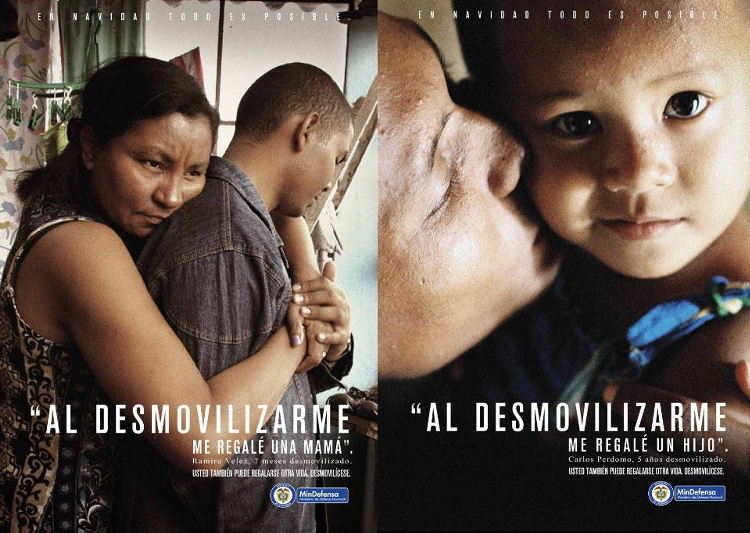
TODAY COLOMBIA (Dialogo America) Guerrilla groups are reeling from the continuing success of fierce social, military and media demobilization campaigns led by the Colombian government.
In the southeastern state of Caquetá alone, more than 130 members of the Revolutionary Armed Forces of Colombia (FARC) have left the guerrilla group this year – and in total, more than 1,240 men, women and children have demobilized throughout the country, according to the Ministry of Defense.
“Lately, some of the longstanding members of the guerrilla are demobilizing,” said Captain Ronal Romero, Planning Chief of the Ministry of Defense’s Group of Humanitarian Attention for the Demobilized (GAHD), an organization that provides financial, social and psychological support to guerrilla members who turn themselves in. “We are seeing that many of them feel disillusioned by the way things are going.”
The recent wave of demobilizations is a result of increased military pressure on one hand and the coordinated efforts of six different government institutions on the other. Those efforts, managed by GAHD and the Colombian Agency for Reintegration (ACR), provide benefits to those who renounce their weapons and pledge to follow a path towards social reintegration. Altogether, this two-tiered strategy has led to the disbandment of nearly 13,000 guerrillas since 2008.
Former guerrilla members who want to demobilize and enjoy all the judicial and financial benefits the government offers must follow a relatively strict path. First, they must turn themselves in at a police station or at an Army unit, where they will be housed, fed, and clothed for about two weeks.
“The whole path towards reintegration starts with a process of reconciliation,” Capt. Romero said. “The Soldier welcomes the guerrilla member who chooses to demobilize. He shakes the hand of his former enemy.”
After turning themselves in, former guerrillas are interviewed and then required to sign an affidavit, stating the criminal group they used to belong to and forsaking any further involvement with it. Authorities compile a file with this information and send it to Bogotá, where it is evaluated by a special committee formed by envoys of the Ministry of Justice, the Ministry of Defense, and other government institutions. The committee analyzes each individual’s claims and looks at their criminal records in order to approve them for a number of financial and judicial benefits. So far this year, 82 percent of the claims were accepted.
All demobilized men and women are given housing in rural residences known as Peace Homes; there are specific facilities for men, women, and families. Most people stay in these communal houses for 60 to 90 days, where they receive food, psychological evaluations, basic education, health services, and a clothing bonus of about $300. Additionally, they’re given about $3 per day to spend on whatever they prefer. Each former guerrilla’s reintegration process costs about $1,300, according to the GADH, and everything is fully funded by the Colombian government.
On the judicial side, crimes associated with armed rebellion – such as the illegal possession of firearms, the use of privileged communications, and the illegal use of Army uniforms – are pardoned. However, crimes like murder, kidnapping, and drug trafficking carry normal sentences.
Following their initial stay in the peace homes, former guerrillas are urged to move to cities where they can work closely with personnel from the ACR’s reintegration centers. They must serve 80 hours of community service and follow certain protocols in order to earn money. At the end of each month, they can receive up to $240 if they attend high school – approximately 85 percent of all demobilized men and women only have a primary education – a technical college education fully paid for by the government, and regular meetings at one of the ACR’s 32 reintegration centers.
All of these benefits have been publicized through massive media campaigns, including pamphlets dropped in the jungles, spots aired on local and national radio stations, and TV commercials. The media campaigns often run during strategic events – like the World Cup and Christmas – times when guerrilla fighters feel the most alone, according to Capt. Romero.
The Ministry of Defense spends an average of $3 million per year on massive media campaigns to promote demobilizations. They have been so successful that in 2012 and 2014, the demobilization television ads even won Cannes Lions, the advertising industry’s most prestigious awards. But that recognition is just a minor indicator of the program’s success.
“We are offering people the services they need,” Capt. Romero said. “And more importantly, they are returning to society.”