EL RETIRO, Colombia — Crouched on all fours and sweating beneath his Kevlar jacket, Edwin Ramirez slowly cleared dirt from around the fist-size red tube buried in the ground.
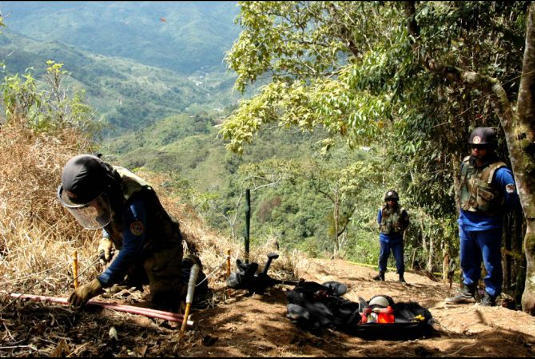
There was no reason for Ramirez to fear: this landmine was a training dummy. But in a few months, Ramirez will be tracking down the real thing as part of the hemisphere’s first civilian demining program.
Colombia’s 48-year civil conflict has made this Andean nation one of the most heavily-mined countries in the world. Last year, 75 people were killed and 404 were injured by mines – putting it just behind Afghanistan and Pakistan in terms of victims. In the last 22 years, landmines have claimed 10,160 victims here.
Even while the government and the nation’s largest guerrilla group, the Revolutionary Armed Forces of Colombia, or FARC, are in the midst of peace talks in Havana, there are clear signs that new mines, known here as quiebra patas, or foot breakers, are being laid down faster than the military can find them.
That’s why the country is opening its doors to civilian demining organizations.
“Traditionally, demining is something in Latin America that has been done by the military and this is a brand new concept for the region,” said Grant Salisbury, program manager for the Halo Trust, the U.K.-based organization that began training Ramirez and others for the job. “There is a crying need, particularly in Colombia, for humanitarian civilian mine action.”
Halo’s first group of 13 recruits is training at an abandoned schoolhouse about an hour outside of Medellin. By year’s end, the organization hopes to have 200 people trained as mapmakers, deminers and paramedics. While the salary hasn’t been set, workers are expected to make better than minimum wage, which is about $331 a month.
The training site was chosen precisely because it has no history of landmine contamination, but most of the recruits have seen the damage the explosives do first hand.
Gloria Nancy Vasquez, 23, was riding a mule in 2005 near her town of Argelia when it stepped on a landmine. The blast killed the mule and left Vasquez partly blind and deaf on her left side. She’s had multiple skin grafts on her arm and leg.
Vasquez said the last two months of training have forced her to overcome her fear of landmines, and she’s looking forward to helping other affected villages.
“To be able to survey an area and then hand it back to the community clean (of landmines) would make me very proud,” she said, as she sat beneath a statue of the Virgin Mary. “I wouldn’t wish my experience on anyone.”
Civilian demining efforts are common in other parts of the world (Halo works in 13 countries), but it has taken some getting used to here.
Last year, the attorney general’s office warned the government against allowing civilian operators, saying the human and legal risks were too high.
“Humanitarian demining by civilians in the middle of the conflict could … expose them to exceptional risks,” the attorney general’s office wrote. Instead, the office recommended reinforcing the army’s bomb-squad.
But those concerns were ultimately assuaged, and the government is in negotiations with four civilian demining organizations – Halo, the Swiss Foundation for Mine Action, Indra-Atex and Ronco – and hopes to put them to work within months.
As a signatory to the Ottawa Treaty, Colombia has pledged to clear all landmines by 2021. But there’s no way to do that without civilian help, said Daniel Avila Camacho, director of the presidential antipersonnel mine program, which oversees demining efforts.
Even so, Avila said the government is proceeding cautiously. The FARC and smaller ELN guerrillas have been known to retaliate against communities that identify or remove minefields, so efforts are being made to show these programs are purely humanitarian.
“We’ll be working minefields that no longer have any strategic value to the FARC or ELN and have been abandoned, but are still a risk to anyone who goes through the area,” he said. “Of course, civilian demining has risks. … But these organizations have experience and we have clear ground rules.”
The government says 31 out of the country’s 32 departments have some degree of landmine contamination, and cleaning up swaths of the countryside is critical to the administration’s plans to return thousands of acres to farmers who have been forced off their land by the violence.
Colombia’s guerrillas are experts at creating improvised explosives. Some of the quiebra patas use syringe plungers as triggers, others rely on clothes pins and trip wires. Many are crude, but they’re effective.
“Mines have become for the FARC what aviation is for the Armed Forces of Colombia,” said Alvaro Jimenez Millan, national manager of the Colombian Campaign Against Mines. “They are a strategic weapon and the FARC are manufacturing them intensively.”
Even during a unilateral ceasefire that the guerrillas called from November through January, there were indications that the group was still planting mines, authorities said.
While the guerrillas plant the mines targeting the military, it’s civilians who often fall into the trap. In recent days, a 17-year-old pregnant woman and her boyfriend in Putumayo Province stumbled across a mine as they wandered into a field looking for a cell phone signal. Three teenagers in Antioquia hit a landmine as they were coming home at night, leaving one of them dead. A 10-year-old boy in Cauca Province stepped on a landmine, blinding his left eye. During the first 21 days of this year, there were four civilian fatalities and 12 injuries due to landmines.
The mention of a bomb-squad can conjure up images of soldiers in bulky body armor diving away from explosions. But the work looks more like slow-motion gardening. Trainees methodically wave metal detectors over the dirt then gingerly dig at the ground, snipping at roots and pieces of grass with shears as they inch forward. A fully trained de-miner might cover 12 square-feet a day. At that rate, it would take six days to clear a basketball court.
But the process works. Halo’s 8,000 worldwide employees cleared more than 65,000 landmines last year and had only one, non-fatal, accident, Salisbury said.
“Obviously, one accident is far too many,” he said. “But for the benefit of preventing 65,000 accidents from occurring, I think that is well worth the time and investment that we put into it.”
©2013 The Miami Herald
Source: Mcclatchydc.com