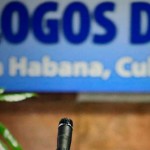
The government of Colombia and the country’s largest rebel group FARC have been engaged in peace talks since November 19, 2012.
PROFILE: FARC
The state and guerrillas that have been at war since 1964 agreed to hold these talks in Cuba. The talks received the formal guarantees of Norway and Chile and are additionally sponsored by Cuba and Venezuela.
In order to advance the process, the negotiators agreed to a fixed agenda before formally beginning the negotiations.
The agenda is based on a signed preliminary General Agreement that functions as the framework that defines which demands can be made and which not.
The talks have basically been split up in six different themes that will be agreed on separately before a ceasefire is agreed and a peace deal is signed.
On the six points on the agenda, three points have been agreed on, two are currently being negotiating while the last one, the implementation of the deal, is pending..
Skip to
Top – Agenda – General Agreement – Timeline – Government delegation – FARC delegation – Resources
Agenda
The government and FARC negotiators agreed to a fixed agenda before formally beginning the negotiations. This agreements functions as the framework within the negotiations take place. This framework was formally put on paper in a general agreement.
The talks have basically been split up in six different themes that.
Rural ReformAgreed |
Political ParticipationAgreed |
Illicit DrugsAgreed |
VictimsCurrently negotiated |
End of conflictCurrently negotiated |
ImplementationPending |
What is we put text here.
Skip to
Top – Agenda – General Agreement – Timeline – Government delegation – FARC delegation – Resources
General Agreement
According to the General agreement signed by both parties at the beginning of the formal talks, each theme will be discussed separately.
General Agreement for the Termination of the Conflict and the Construction of a Stable and Lasting Peace
The delegates of the Government of the Republic of Colombia (National Government) and the Revolutionary Armed Forces of Colombia-People’s Army (FARC-EP);
As a result of the Exploratory Meeting in Havana, Cuba, between February, 23 and August 26, 2012, and which counted on the participation of the Government of the Republic of Cuba and the Government of Norway as guarantors, and with the support of the Government of the Bolivarian Republic of Venezuela as facilitator of logistics and companion;
With the mutual decision of putting an end to the conflict as an essential condition for the constitution of stable and lasting peace;
Attending the clamor of the population for peace, and recognizing that:
The construction of peace is an issue of the society as a whole that requires the participation of everybody, without distinction, including other guerrilla organizations which we invite to join this proposal;
Respect for human rights in every corner of the national territory is a state purpose that should be promoted;
Economic development with social justice and in harmony with the environment is a guarantee of peace and progress.
Social development with equality and well-being, including the majorities, allows us to grow as a country;
A Colombia in peace will play an active and sovereign role in regional and global peace and development.
It is important to amplify democracy as a condition to achieve solid bases for peace;
With the full disposition of the National Government and the FARC-EP to reach an agreement, and the invitation to the entire Colombian society, as well as organisms of regional integration and the international community, to accompany this process;
We have agreed:
- To initiate direct and uninterrupted conversations about the points of the Agenda established here, with the purpose of reaching a Final Agreement for the termination of the conflict that will contribute to stable and lasting peace.
- To establish a Table of Conversations that will be installed publicly (in the first two weeks of October 2012) in Oslo, Norway, and whose main site will be Havana, Cuba. The Table could have meetings in other countries.
- To guarantee the effectiveness of the process and conclude the work about the points of the agenda expeditiously and in the least amount of time possible, to fulfill the expectations of the society concerning the agreement. In any case, the duration will be subject to periodic evaluations of progress.
- To develop the conversations with the support of the governments of Cuba and Norway as guarantors and the governments of Venezuela and Chile as accompanying countries. In accordance with the needs of the process and by agreement, others could be invited.
- The following Agenda:
1. Comprehensive agricultural development policy (agreed)
Comprehensive agricultural development is crucial to boost the integration of the regions and the equitable social and economic development of the country.
- Access and use of land. Wastelands. Formalization of property. Agricultural border and protection of reserve zones.
- Programs of development with a territorial focus.
- Infrastructure and land improvement.
- Social development: health, education, housing, eradication of poverty.
- Stimulus to agricultural production and the economy of solidarity and cooperation. Technical assistance. Subsidies. Credit. Generation of income. Marketing. Labor formalization.
- Food security system.
2. Political participation (agreed)
- Rights and guarantees for the exercise of the political opposition in general and in particular for the new movements that arise after the signing of the Final Agreement. Access to the media.
- Democratic mechanisms of citizen participation, including those of direct participation, on different levels and diverse themes.
- Effective measures to promote greater participation in the national, regional and local policy of all sectors, including the most vulnerable population, equality of conditions and with guarantees of security,
3. End of the conflict
Integral and simultaneous process which implies:
- Bilateral and definitive cease of fire and hostilities.
- Abandonment of arms. Reincorporation of the FARC-EP into civil life – economically, socially and politically -, in accordance with their interests.
- The National Government will coordinate the revision of the situation of individuals, charged or convicted, for belonging to or collaborating with the FARC-EP.
- Parallel, the national government will intensify the fight to end the criminal organizations and their support networks, including the fight against corruption and impunity, in particular against any organization responsible for homicides and massacres or that undermines human rights defenders, social movements or political movements.
- The National Government will revise and make the reforms and institutional adjustments necessary to address the challenges of the construction of peace.
- Guarantees of security.
- Under the provisions of Point 5 (Victims) of this agreement, the issue of paramilitarism, among others, will be clarified.
The signing of the Final Agreement initiates this process, which must develop in a reasonable time agreed by the parties.
4. Solution to the problem of illicit drugs (agreed)
- Illicit crop substitution programs. Integral development plans with participation of the communities in the design, execution and evaluation of the programs of substitution and environmental recovery of the areas affected by illicit crops.
- Prevention programs of consumption and public health.
- Solution to the phenomenon of production, consumption and public health.
5. Victims
To compensate the victims is in the center of the agreement National Government – FARC-EP. In this sense they will treat:
- Human rights of the victims.
- Truth.
6. Implementation, verification and countersignature
The signing of the Final Agreement begins the implementation of all of the agreed points.
- Mechanisms of implementation and verification
- System of implementation, with special importance for the regions.
- Commissions of monitoring and verification.
- Mechanisms of resolution of conflicts.
These mechanisms will have the capacity and executive power, and will be conformed by representatives of the parts and of society, as appropriate.
- International accompaniment
- Schedule.
- Budget.
- Tools of dissemination and communication.
- Mechanism of countersignature of the agreements.
VI. The following operating rules:
- In the sessions of the Table up to 10 people will participate per delegation, of which up to 5 will be plenipotentiaries who will carry the respective voice. Every delegation will be made up of up to 30 representatives.With the end of contributing to the development of the process they can realize consultations of experts about the themes of the Agenda, once the corresponding procedure is sorted.
- To guarantee the transparency of the process, the Table will elaborate periodic reports.
- A mechanism will be established to make public the advances of the Table. The discussions of the Table will not be made public.
- A strategy of effective diffusion will be implemented.
- To guarantee the broadest participation possible, there will be established a mechanism of reception of proposals about the points of the agenda of citizens and organizations, by physical or electronic means. By mutual agreement and at some specific moment, the Table can make direct consultations and receive proposals about the points mentioned, or delegate to a third party the organization of spaces of participation.
- The National Government will guarantee the necessary resources for the Table to work, that will be administered in an efficient and transparent manner.
- The Table will have the necessary technology for the process to advance.
- The conversations will initiate with the point of integral agricultural development policy and will continue with the order the Table agrees on.
- The conversations will be hold under the principle that nothing is agreed until everything is agreed.
Skip to
Top – Agenda – General Agreement – Timeline – Government delegation – FARC delegation – Resources
Timeline
2012 – 2013 – 2014
August 27 – Colombian President Juan Manuel Santos and FARC representatives sign a preliminary agreement in Havana, Cuba to begin peace talks.
September 4 – Santos and FARC leaders announce they have signed an agreement to begin peace talks.
October 18 – Negotiators from the Colombian government and the FARC held a press conference in Norway to mark the start of the process.
October 22 – The Colombian government lifted 191 arrest warrants in order for 29 FARC negotiators to participate in the talks. Attorney General Eduardo Montealegre explained that the suspensions were only valid in Norway and Cuba, where negotiations will take place. “If one of the 29 FARC members goes to a place unauthorized by the government or peace commissioner, arrest orders will be made,” he said.
November 6- After initial dialogues in Oslo, representatives from both sides moved to Havana to discuss logistics ahead of the official start to talks.
November 12 – In a letter, the National Liberation Army (ELN) expressed a desire to begin exploratory talks to potentially join the peace process.
November 19: Talks got underway officially in Havana, Cuba. As the talks began, FARC announced a two-month unilateral ceasefire.
November 25: Negotiators announced a public forum on agrarian reform to be held in Bogota in December.
November 29: The first round of Havana talks ended. The government announced the launch of awebsite for citizens to contribute to discussions on the peace talks.
December 2: Santos set a November 2013 deadline for the end of the talks.
December 19: The three-day public forum on agricultural reform concluded in Bogota.
Skip to
Top – Agenda – General Agreement – Timeline – Government delegation – FARC delegation – Resources
Timeline
2012 – 2013 – 2014
January 14: During the January round of talks, both sides discussed the proposals on agrarian reformthat emerged during the December public forum in Bogota.
January 20: The FARC announced its unilateral two-month ceasefire would not be extended.
January 24: A government ceasefire still remained off the table, negotiator Humberto de la Calle said.
May 26: In a joint statement, negotiators said that they reached an agreement on land reform.
June 11: Negotiators begin the tenth round of talks, and broach the second agenda topic on political participation for former FARC guerrillas. FARC representatives propose delaying the 2014 legislative and presidential elections by a year, and put forward the idea of a constituent assembly. Humberto de la Calle, the chief government negotiator, says no to both proposals.
July 1: In a joint statement, representatives of the FARC and ELN say they held a joint meeting and agreed to work towards “a political solution to the social and armed conflict.”
August 22: Santos announces a plan to submit an eventual peace accord to a public referendum.
August 23: FARC negotiators suspend the talks to consider the government’s proposal for a referendum on a future peace accord.
August 26: Despite the brief suspension, negotiations resume in Havana.
August 28: Colombia’s Constitutional Court upholds the Legal Framework for Peace, a critical piece of legislation for the talks.
September 1: The Santos administration sends a bill to Congress to hold a referendum on a future peace accord.
September 9: The government announces it will begin talks with the ELN, in a different location from the FARC talks in Havana.
September 11: A bicameral committee in Congress postpones debate on the peace referendum.
September 17: The peace accord referendum bill passes its first hurdle in Congress, and is approved by committees in both houses. The bill will now be debated by the House and the Senate.
September 24: Santos asks for global support for the peace process during his address at the General Debate of the UN General Assembly..
Skip to
Top – Agenda – General Agreement – Timeline – Government delegation – FARC delegation – Resources
Timeline
2012 – 2013 – 2014
November x – Santos embarks on a five-day European tour to seek political goodwill for the foundation of a fund that could finance a “Marshall Plan” for Colombia.
Skip to
Top – Agenda – General Agreement – Timeline – Government delegation – FARC delegation – Resources
Government delegation

(Photo: Government Peace Delegation)
Humberto de la Calle
The former vice president and ex-minister of state is a 66-year-old lawyer and politician that was born in Manzanares of the northwest Caldas department. Of liberal affiliation, De la Calle has had an impressive political career. He studied law in the University of Caldas and specialized in international law. Several of the prominent positions he has held include judge of the Supreme Court, Minister of Government under Cesar Gaviria, Vice President under Ernesto Samper, Colombian ambassador in Spain, and Interior Minister under Andres Pastrana between 2000 and 2001. De la Calle has now been designated as head of the negotiating team in talks with the FARC.
PROFILE: Humberto de la Calle
(Photo: AFP)
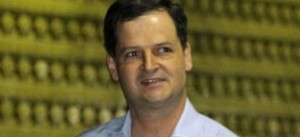
Sergio Jaramillo
The Presidential Security Adviser was announced as the Peace Commissioner by Santos, confirming that he would be the voice of the government in the table of negotiations with the FARC. The philosopher from Bogota was vice-minister of Defense and was in charge of the first phase of “exploratory negotiations.” He had already been working as plenipotentiary when he finalized talks in Cuba. Jaramillo has been an adviser in human rights during the first term of Alvaro Uribe, and drafted the document of the democratic security policy. He was in the government until 2004, and then went on to direct the foundation “Ideas for the Peace,” in which he continued with themes of the armed conflict and security. He was also vice-minister for human rights and international points for the Defense Ministry.
EDITORIAL: Transition in Colombia
(Photo: Policia Nacional)
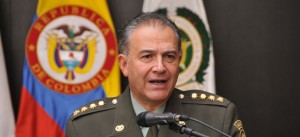
Oscar Naranjo
The internationally awarded former general Oscar Naranjo was director of the National Police. After retiring he was designated as adviser in security for the Mexican President Enrique Peña Nieto. During his 35 years with the National Police, Naranjo was commander of several departments as well as commander of Special Operations and the Directorate of Intelligence and Counterintelligence. He was also a part of operations in which authorities took down important drug trafficking leaders, such as Gonzalo Rodriguez Gacha and Pablo Escobar. Naranjo will be an important voice in the theme of drug trafficking during the table of negotiations.
NEWS ARCHIVE: Oscar Naranjo

(Photo: Environment Ministry)
Frank Pearl
As ex-commissioner of peace and ex-minister of the environment, Pearl took part in the first phase of the peace process as plenipotentiary along with Jaramillo. The economist from Bogota promoted and defended the criticized Justice and Peace process during the government of Alvaro Uribe, and realized the demobilization of paramilitary group ERPAC. Along with Piedad Cordoba, he participated in the the liberation of kidnapped persons. Pearl also had a lot of influence during exploratory meetings with FARC leaders in Cuba.
NEWS ARCHIVE: Frank Pearl

(Photo: Interior Ministry)
Maria Paulina Riveros
Maria Paulina Riveras is the former Human Rights director at Colombia’s Interior Ministry. The attorney has a long career in law and policy. She replaced Luis Carlos Villegas after he had been appointed ambassador to Washington D.C. and has become the delegation’s leader when it comes to debating women conflict victims.
NEWS ARCHIVE: Maria Paulina Riveros

(Photo: Asociación de Estudios Coreanos en Colombia)
Jorge Enrique Mora
General Jorge Enrique Mora was commander of the army between 1998 and 2002, during the government of Andres Pastrana. During this time, he participated in the failed peace process. Santos praised Mora’s role in the military and perceives him as an asset during current negotiations.
NEWS ARCHIVE: Jorge Enrique Mora
Former members

(Photo: Andi)
Luis Carlos Villegas
Since 1996, Juan Carlos Villegas has been head of the National Industrial Association. The lawyer and socio economist is also President of Colombia’s Business Association. He was vice-minister and acting foreign minister, and held positions as a governor and senator. He has participated in dialogue processes in the National Council of Peace as well as conversations with the ELN in Cuba and Costa Rica. Villegas left the government delegation to become ambassador in the United States.
NEWS ARCHIVE: Luis Carlos Villegas
Skip to
Top – Agenda – General Agreement – Timeline – Government delegation – FARC delegation – Resources
FARC delegation

(Photo: FARC-EP)
Ivan Marquez
“Ivan Marquez” is one of the FARC’s most important political leaders and member of the Colombian guerrilla group’s Secretariat. After the FARC’s decision to begin peace talks with the government, the senior rebel was appointed leader of the rebel delegation that will negotiate peace with the government in Norway and Cuba. Previously, Marquez took part in several of the FARC’s political initiatives. Marquez, whose real name is Luciano Marin, was born in 1955 in the southern Colombian town of Florencia, Caqueta and has been with the FARC since he was 22.
PROFILE: Ivan Marquez

(Photo: FARC-EP)
Pablo Catatumbo
Pablo Catatumbo, nom-de-guerre of Jorge Torres Victoria, is the commander of the leftist rebel group FARC’s most powerful fighting unit, the Western Bloc and is adviser to the group’s Adan Izquierdo Joint Command, also known as the Central Bloc. Catatumbo was born in 1953 in Colombia’s third largest city, Cali, located in the southwestern Valle del Cauca department, near the traditional heartland of the FARC rebels in the Cauca and Tolima states. Before joining the FARC, Cactumbo was a member of the now-demobilized guerrilla group M-19.
PROFILE: Pablo Catatumbo
Skip to
Top – Agenda – General Agreement – Timeline – Government delegation – FARC delegation – Resources
Resources
Peace talks organizers and participants
External recourses |
News
Profiles
The post Colombia peace talks fact sheet appeared first on Colombia News | Colombia Reports.