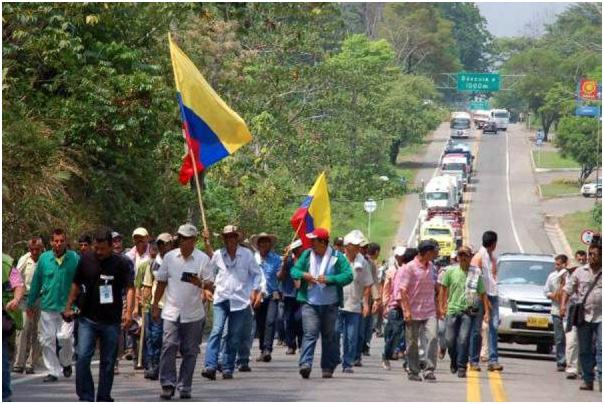
About 200,000 farmers, transporters and miners mobilized 50,000 trucks paralyzing 27 departments (states), more than 30 roads blocked, one dead, 50 injured, 100 arrested and the likelihood that the Cauca Indigenous and peasant Catatumbo region joins in the coming hours to protest, as Colombia endures its fourth day of strikes.
At least seven agriculture sectors are involved in the national strike that began Monday, to which truckers, teachers and workers engaged in small-scale mining, joined in the protest that began with growers of coffee, cocoa, cotton, potato, rice and corn among others.
Echoing the widespread social discontent that swept through Brazil last month, demonstrators have taken to the streets in Colombia to protest various issues ranging from agrarian reform to ending a crackdown on illegal mining.
“We’re not trying to overthrow the government or support one armed group or another, we just want solutions to our problems,” Javier Correa Velez, the head of a coffee-growers association called Dignidad Cafetera, told the media. “The strike is simply a symptom of an illness that the entire agriculture sector is suffering from.”
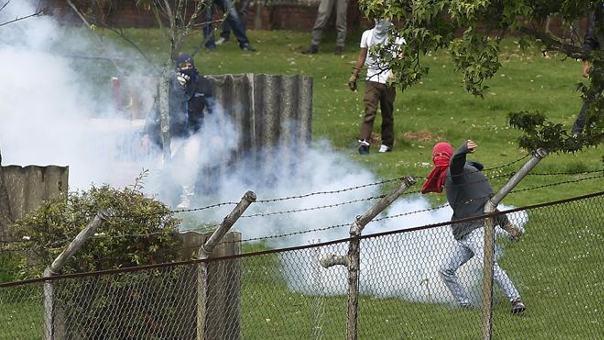
While the unrest in made up of varying groups of workers, many of their concerns are interconnected and mainly focused on what they deem to be failings of the government. Truckers are angry about low wages and high gas prices, coffee workers want relief for their bankrupt industry and miners are fighting against government interventions.
The strike is a continuation of unrest in March when farm workers blocked Colombia’s main roads for 12 days, stranding several of the country’s departments without supplies. Colombian president Manuel Santos was able to avert that crisis by promising to raise the minimum wage for farmers.
For his part, Santos has remained steadfast in his feelings that he won’t give in to protestors’ demands and said the situation won’t simply go away by throwing more money at the problem. He added that the protests were not as big as expected and thanked those who didn’t participate.
“I want to thank the citizens for their collaboration in giving out information to the authorities, who were able to keep the situation under control,” he said, according to El Tiempo.
The protests come at a dicey time for the Santos government, as it continues its peace talks with the guerilla group Revolutionary Armed Forces of Colombia, commonly known a FARC, to end the 60-plus year civil conflict between the government and Latin America’s longest-running rebel group.