COLOMBIA NEWS (Bloomberg) — To see how far Colombia has come in the past 15 years, just take a look at its banking industry.
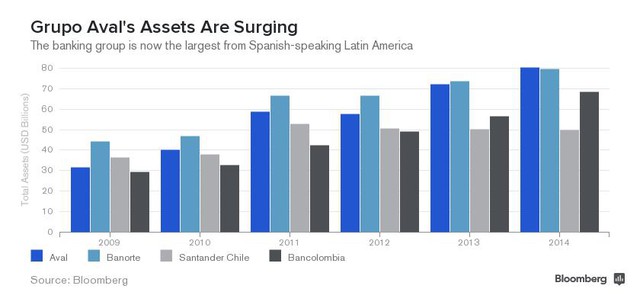
Grupo Aval Acciones y Valores SA, controlled by billionaire Luis Carlos Sarmiento Angulo, has overtaken lenders including Mexico’s Grupo Financiero Banorte SAB to become Spanish-speaking Latin America’s biggest banking group by assets. Colombian banks have spent $10 billion expanding abroad since 2007, more than triple that of their Chilean counterparts, picking up assets from European companies seeking to raise capital in the aftermath of the global credit crisis.
The growth in financial services is a testament to the success that President Juan Manuel Santos, and his predecessor Alvaro Uribe, have had turning the tide in a 50-year war with Marxist rebels, bolstering economic growth and regaining the investment-grade rating the country lost in 1999. Financial services now account for a fifth of Colombia’s $380 billion economy, marking a stark turnaround from the beginning of the century, when lenders needed a bailout after a recession and high unemployment lead to defaults on loans.
“A country’s economy and its financial system go hand in hand,” Munir Jalil, chief economist for Colombia and Venezuela at Citigroup Inc. in Bogota, said in a telephone interview. “It’s a success story that’s tied to economic growth.”
With expansion exceeding the Latin American average by 1.1 percentage points over the past seven years and the share of Colombian adults using banks surging, lenders turned to Central America to find new opportunities.
Panama, Guatemala
Bancolombia SA, which closed its purchase of HSBC Holdings Plc’s Panamanian unit last year, has spent more than $3 billion in Central America since 2007, buying stakes in lenders from Guatemala to El Salvador. Grupo Aval has spent about $3 billion in the region since 2010, including the purchase of Banco Bilbao Vizcaya Argentaria SA’s Panama subsidiary in 2013.
Banco Davivienda SA completed the $830 million acquisition of HSBC’s assets in Costa Rica, El Salvador and Honduras in 2012.
The banks have invested more than $10 billion outside the nation since 2007 and have spread to 21 countries in Latin America and the Caribbean, according to a 2013 report from Colombia’s banking association.
While assets at Grupo Aval and Bancolombia have surged, profitability at both lenders is still about half the 3.5 percent average return on assets posted by financial companies in the region, according to data compiled by Bloomberg.
Shares of Davivienda and Bancolombia have increased at least 25 percent this year in Bogota. That compares with the 7.4 percent gain for the benchmark Colcap index. Grupo Aval shares have rallied 13 percent.
New York
“Expectations for Colombia were so low for so long that it was easy to surprise on the upside when things weren’t as bad as people expected,” Adam Kutas, a portfolio manager at Fidelity Investments, said in a telephone interview. “What they need to do now is show the profitability of all the acquisitions. They spent a lot of capital getting their footprint in there.”
Aval now plans to raise $1.1 billion by selling shares in New York for the first time, a goal it has had since its Colombian initial public offering 15 years ago. The proceeds will help raise capital at its subsidiaries, including Banco de Bogota SA, through which most of its acquisitions were made.
Colombia still has comparatively low usage levels of banking services, signaling an opportunity for lenders to keep growing at home, according to Citigroup’s Jalil.
While the percentage of adults with at least one financial product increased to 71.5 percent in 2013 from 62.2 percent three years earlier, only 43 percent of Colombians have an active savings account, according to the banking association.
“Banking penetration has improved a lot, and having less risk in the country, combined with the growth of the middle class, the cake increases a lot,” Eric Conrads, who helps oversee about $500 million in Latin American stocks as a money manager at ING Groep NV in New York, said in a telephone interview. “The future is looking good for banks in Colombia.”