In a city where Justin Bieber can graffiti off-limit walls with a police escort, street artists welcome a new tolerance for their art. But has legitimacy ruined the fun?
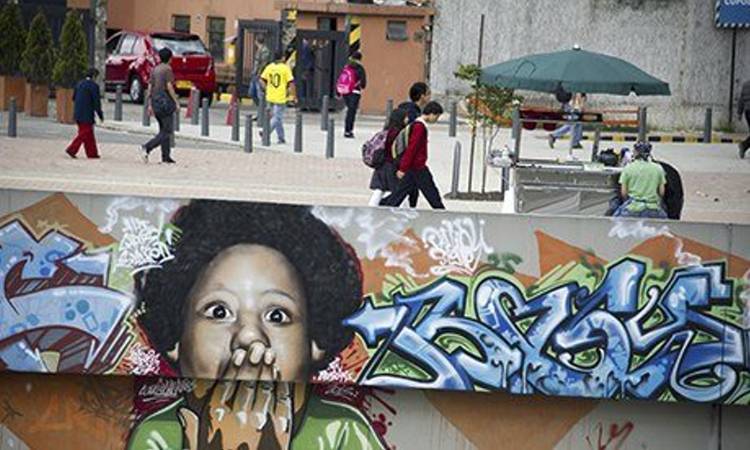
When graffiti artist DJ Lu began leaving his mark on the walls of Bogotá, he did it under the cover of night, dodging police who he knew could harass him, shake him down, arrest him, or worse.
“When I started out eight years ago it was risky,” says DJ Lu, a prolific stencil artist whose images of a pineapple bomb, an amputee with an AK-47 as a crutch, and a soldier holding grenade balloons occupy walls citywide. “There were no real rules and anything could happen.” But today, instead of hunting down graffiti artists, authorities in the Colombian capital are hiring them.
It was the death of a young artist, shot by a policeman in 2011, which sparked a new tolerance of street art that has exploded into a colourful free-for-all of artistic expression. Diego Felipe Becerra was spray-painting his signature wide-eyed Felix the Cat image on the walls of an underpass when he was killed.
The outcry over the incident – and over a police attempt to portray Becerra as a suspected armed robber – led to graffiti protests across the city as well as the arrest of two police officers. “His killing was a turning point for street art in the city,” DJ Lu says.